
Medically reviewed by Dr. R. Bharathkumar and Dr. S Mohamed Nizamuddin, Orthopaedics, Kathir Hospital, Trichy | Dr. R. Bharathkumar: M.B.B.S., M.S. (Orthopaedics) | Dr. S Mohamed Nizamuddin: M.B.B.S., Diploma in Orthopaedics, Diploma in Physical Medicine and Rehabilitation | Last reviewed: October 2026
Think about the small things a painful joint takes away. Getting into an auto without wincing. Sleeping through the night without your hip waking you up. Climbing stairs without planning your whole day around them. Many people live like this for years. Some hope the pain will fade on its own, and others put it off because the word “replacement” sounds frightening.
Here is something that may ease your mind. Joint replacement is a well-established procedure in orthopaedics, but it is never the first step for anyone, and it is not right for everyone. Most people begin with simpler measures, and surgery comes into the picture only when the joint is badly damaged and those measures no longer help enough.
This page is meant to take the fear out of the decision. You will find what joint replacement surgery is, when doctors consider it, what the operation and recovery involve, and which questions are worth asking your surgeon. If you are looking into joint replacement surgery in Trichy, you will also see how orthopaedic care is approached at Kathir Hospital, Woraiyur, Tiruchirappalli, where knee replacement and hip replacement are listed among the hospital’s orthopaedic centres.
What Is Joint Replacement Surgery?
A joint is where two bones meet and move against each other. Healthy joints are lined with smooth cartilage that lets them glide with little friction. When that cartilage wears away, the bones rub, causing pain, stiffness, swelling and reduced movement.
In joint replacement, which doctors also call arthroplasty, the damaged surfaces of the joint are removed and replaced with artificial components made of metal, high-grade plastic or ceramic. The goal is to reduce pain and improve movement and function. Depending on how much of the joint is damaged, either part of the joint or the whole joint may be replaced.
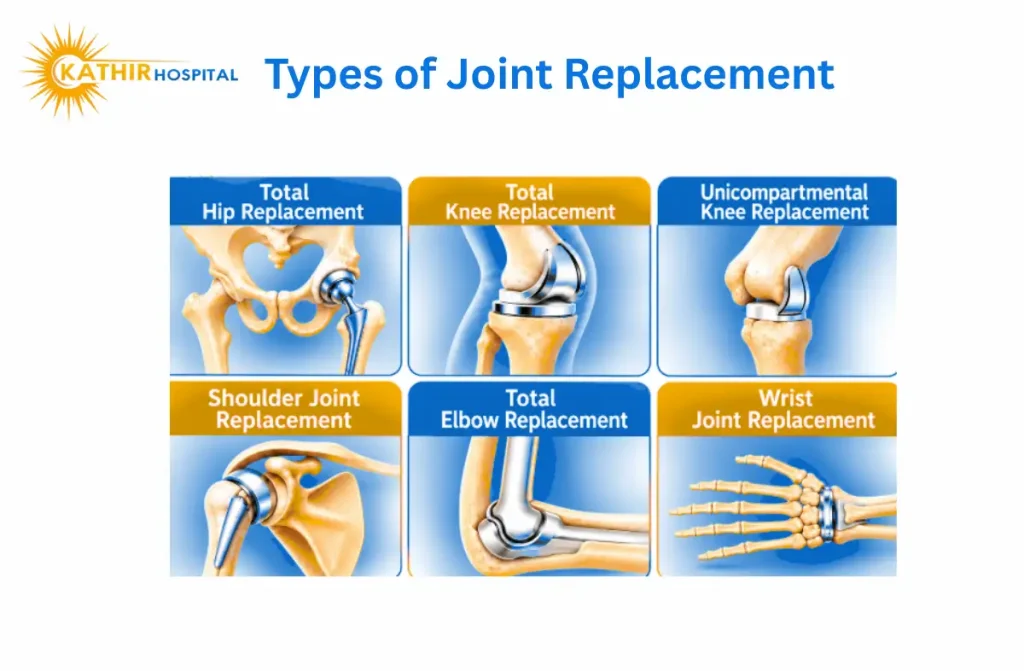
The knee and hip are the most commonly replaced joints. Shoulders, elbows and other joints may also be considered in selected situations.
Why Do Joints Wear Out?
Several conditions can damage a joint to the point where replacement is discussed.
- Osteoarthritis. The most common cause. Cartilage gradually thins with age, use, previous injury, extra body weight or family tendency.
- Rheumatoid and other inflammatory arthritis. The body’s immune system inflames the joint lining and damages cartilage, often at a younger age. These conditions are usually managed together with a physician or rheumatologist.
- Post-traumatic arthritis. A fracture or ligament injury years earlier can leave the joint damaged.
- Avascular necrosis. The bone near a joint loses blood supply, which can cause the bone to collapse. It is a known cause of hip damage in younger adults.
- Hip fractures. In older adults, some fractures of the hip are treated with partial or total hip replacement.
- Other causes. Developmental problems, infection-related damage and certain bone conditions can also affect joints.
Symptoms That May Point to Joint Damage
Joint damage often builds slowly. These are common signs that deserve an orthopaedic opinion:
- Pain in the knee or hip that lasts for weeks or keeps returning
- Pain that is worse when walking, climbing stairs or getting up from a chair
- Morning stiffness or stiffness after sitting
- Swelling, warmth or a grinding feeling in the joint
- A knee that bows inward or outward over time
- Difficulty sitting cross-legged, squatting or using Indian-style toilets
- Pain at night or at rest
- A limp or reduced walking distance
- Pain that no longer eases enough with medicines, exercise or other measures
None of these automatically means you need surgery. They mean it is worth knowing what is going on.
Is Joint Replacement the First Option?
No, and that is an important point. For most people with joint wear, treatment begins with non-surgical measures. These may include:
- Weight management, which reduces load on the knees and hips
- Physiotherapy and strengthening exercises
- Pain-relieving medicines, used carefully and for limited periods
- Walking aids, supportive footwear or knee supports where suitable
- Activity changes
- Injections into the joint, in selected cases
- Treating related issues such as vitamin D deficiency or diabetes
Replacement is usually considered when:
- Pain is persistent and affecting sleep, walking and daily activities
- Scans show significant joint damage
- Non-surgical treatment has been tried properly and no longer gives enough relief
- Your general health is suitable for surgery
- You understand the benefits, limits and risks and wish to go ahead
It is a decision made together with your surgeon, not for you.
Meet the Orthopaedic Team
Dr. R. Bharathkumar
Director, Orthopaedic Surgeon and Spine Specialist
Dr. Bharathkumar completed his MBBS in 2006 at Rajah Muthiah Medical College and his MS in Orthopaedics in 2009 at Sri Ramachandra Medical College. He then undertook fellowship training in spine surgery and advanced endoscopic spine surgery training in Ahmedabad and Hyderabad. His areas of practice include arthroplasty (joint replacement), arthroscopy, trauma surgery and complex spinal conditions. He aims to recommend treatment based on each patient’s individual medical needs, with attention to safety and recovery.
Dr. S Mohamed Nizamuddin
Consultant, Orthopaedics
M.B.B.S., Diploma in Orthopaedics, Diploma in Physical Medicine and Rehabilitation
Dr. Nizamuddin focuses on careful evaluation and management of patients with orthopaedic and rehabilitation needs. He looks at symptoms, medical history and physical condition before planning care, and believes follow-up and guidance are central to recovery. His training in physical medicine and rehabilitation is especially relevant to life after joint surgery, when movement, strength and confidence need to be rebuilt.
If you are not sure which doctor to see, the hospital team can guide you when you call.
How Your Joint Is Evaluated
A thorough evaluation comes before any decision about surgery.
- A conversation. The doctor asks about your pain, how long you have had it, what helps or worsens it, how far you can walk, whether you can manage stairs and what you are no longer able to do. Previous injuries, surgeries, medicines and conditions such as diabetes, blood pressure or heart disease are noted.
- Examination. The doctor checks your joint’s movement, stability, alignment and strength, and watches how you walk.
- X-rays. Standing X-rays show the space between bones, bone spurs and alignment. They are often the main scan in joint wear. X-ray services are available at the hospital.
- MRI or CT, if needed. These are not required in every case, but may help when the diagnosis is unclear or when other tissues need a closer look.
- Blood tests and fitness assessment. If surgery is being considered, tests and an anaesthesia assessment help check that you are fit for the procedure.
Types of Joint Replacement
Total Knee Replacement
The damaged surfaces at the ends of the thigh bone and shin bone, and sometimes the kneecap, are replaced with artificial components. It is commonly considered for advanced knee arthritis. The hospital lists Knee Replacement as one of its orthopaedic centres.
Partial Knee Replacement
When wear is limited to one part of the knee, only that section may be replaced. It is suitable only for selected patients, and your surgeon will explain whether it applies to you.
Total Hip Replacement
The ball and socket of the hip joint are replaced with artificial parts. It is considered for advanced hip arthritis, avascular necrosis and some fractures. The hospital lists Hip Replacement among its orthopaedic centres.
Partial Hip Replacement
Only the ball part of the hip is replaced. It is commonly used for certain hip fractures in older adults.
Revision Surgery
Sometimes an earlier replacement needs to be corrected or replaced because of loosening, wear or other problems. This is a more complex procedure and is planned individually.
Which option suits you depends on your diagnosis, age, bone quality, activity level and overall health.
Benefits, Limits and Risks
An honest conversation about joint replacement includes all three.
- Possible benefits. Many people experience less pain, better movement and an improved ability to walk and carry out daily activities. Results differ from person to person, and no surgeon can guarantee a particular outcome.
- Limits. An artificial joint is not the same as a natural one. Some activities, such as high-impact sports or heavy lifting, may need to be limited. Not every person gains the same range of movement.
- Possible risks. As with any major surgery, risks include infection, bleeding, blood clots, reactions to anaesthesia, stiffness, loosening or wear of the implant over time, nerve or blood vessel injury, and the possibility that pain is not fully relieved. People with diabetes, heart or lung conditions, obesity or poor nutrition may face higher risks, which is why preparation matters.
Your surgeon will go through these with you in the context of your own health, and consent is taken before surgery.
Preparing for Surgery
Good preparation often makes recovery smoother.
- Optimise your health. Blood sugar, blood pressure and anaemia should be well controlled. If you smoke, stopping helps healing.
- Review your medicines. Tell your doctor about everything you take, including blood thinners, supplements and herbal products, and ask which to continue or stop.
- Get stronger first. Simple, doctor-approved exercises before surgery can make rehabilitation easier.
- Prepare your home. Clear walkways, use non-slip mats, keep essentials within easy reach and consider a raised toilet seat or a chair with arms.
- Plan support. Arrange for a family member to help during the first few weeks.
- Ask questions. Know the procedure, expected hospital stay, rehabilitation plan and what to do if something feels wrong.
The hospital’s nutrition service may help with dietary guidance before and after surgery.
Your Journey, Step by Step
Step 1: Consultation. Share your symptoms and bring earlier scans, reports and medicines.
Step 2: Evaluation. Examination and tests help confirm what is happening.
Step 3: Non-surgical options discussed. If suitable, these are tried or reviewed first.
Step 4: Decision. If replacement is advised, the procedure, benefits, risks and alternatives are explained. You may take time or seek a second opinion.
Step 5: Pre-operative checks. Blood tests, anaesthesia review and instructions on medicines and fasting.
Step 6: Surgery. Performed in the operating theatre under anaesthesia suited to your health. The hospital lists a laminar flow operation theatre.
Step 7: Early recovery. You are monitored in the hospital, pain is managed and you begin to move with guidance, usually soon after surgery.
Step 8: Rehabilitation. Physiotherapy builds strength, balance and confidence, and follow-up visits track healing.
Recovery After Joint Replacement
Recovery is gradual. Your surgeon will give a plan for your own situation, but in general:
- Early movement. Patients are usually encouraged to stand and walk, with support, soon after surgery.
- Pain and swelling. Both are expected and eased with medicines, positioning and elevation. Tell your team if pain is rising.
- Physiotherapy. Daily exercises improve movement and muscle strength. This is the part of recovery that you control most, and skipping it can limit results.
- Wound care. Keep it clean and dry. Report redness, discharge or fever promptly.
- Preventing clots. Your team may advise medicines, compression or leg movements.
- Activity limits. Hip replacement patients may be advised about certain positions. Knee patients may be asked to avoid kneeling or high-impact activity for a period.
- Patience. Swelling and stiffness may take weeks or months to settle, and strength returns gradually.
Rehabilitation services are available at the hospital, and Dr. Nizamuddin’s training in physical medicine and rehabilitation supports this stage of care.
Looking After Your New Joint
- Keep a healthy weight to reduce stress on the implant
- Stay active with low-impact exercise such as walking, cycling or swimming, as advised
- Avoid falls by using good footwear and a safe home environment
- Attend follow-up visits, even when you feel well
- Tell any dentist or doctor about your joint replacement before procedures, and ask whether precautions are needed
- Report new pain, swelling, warmth or a limp promptly
Facilities That Support Orthopaedic Surgery
You can verify the following on the hospital’s website.
- Operating and imaging support. A laminar flow operation theatre, a flat panel C-arm and X-ray services.
- Critical care and emergency. An ICU, laboratory services and emergency trauma care, with the hospital open 24 hours.
- Recovery support. Rehabilitation and nutrition services, plus day care services.
- Orthopaedic centres. Knee Replacement, Hip Replacement, Arthroscopic Surgery, Sports Injuries, Trauma Surgery and Endoscopic Spine Surgery.
Conclusion
Deciding about joint replacement is rarely easy. It is a big step, and it is natural to feel unsure. What helps is clear information, honest discussion of benefits and risks, and time to ask everything you want to ask. Many people find that once the cause of their pain is understood and the options are laid out, the next step feels less daunting.
If you are considering joint replacement surgery in Trichy, Kathir Hospital offers careful orthopaedic evaluation, knee and hip replacement services and rehabilitation support, with Dr. R. Bharathkumar and Dr. S Mohamed Nizamuddin guiding your care. You do not have to decide today. Start with a conversation, bring your scans and your questions and take it one step at a time.